

A cash offer can be a great way to sell: no showings, no repairs, no waiting on a buyer's lender. But "cash offer" covers a wide range, from solid buyers who close on the date they promise to people who lowball, stall or worse. The good news is that a fair offer and a bad one usually look different on paper if you know what to check.
Below we explain how cash buyers build their price, how to tell whether a number is reasonable for your home, and the red flags that should make you slow down. We focus on metro Atlanta and Georgia, but most of it applies anywhere.
Start with what your home is worth today
You can't judge an offer without a realistic idea of your home's value right now, not what a neighbor got in 2022. Metro Atlanta's market has cooled. The median list price was $415,000 in September 2026, the same as a year earlier and about 8% below the June 2022 peak of roughly $450,000, according to Realtor.com data. Homes are also taking longer to sell: the typical listing spent 60 days on the market in September.
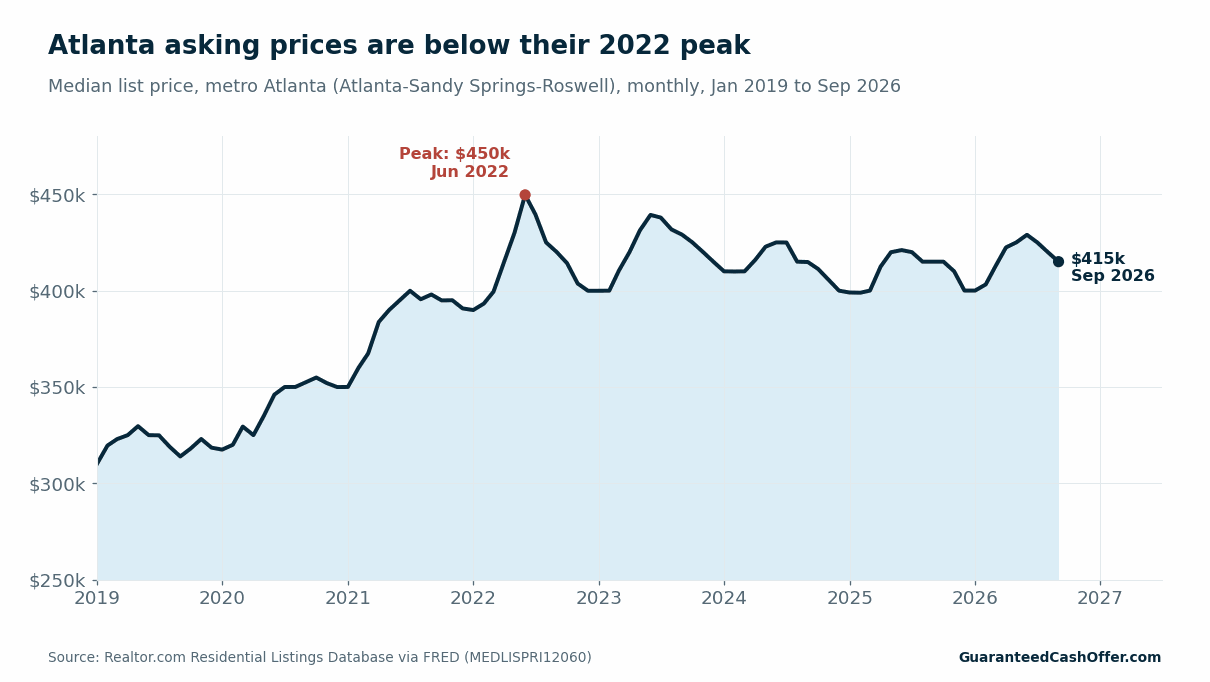
List prices are asking prices, not sale prices, and your street and your home's condition matter more than any metro average. To get a solid number, look at recent nearby sales of similar homes, or ask a licensed agent for a listing estimate. Our look at Atlanta price cuts and concessions explains why many sellers are landing below their first asking price.
How cash buyers build their price
Most investors work backward from what they expect to sell or rent the home for. In plain terms, an investor's offer usually starts with:
- What the home would be worth after repairs, based on recent comparable sales
- minus the repairs they expect to make, often with a cushion for surprises
- minus holding costs like taxes, insurance, utilities and financing while they work on it
- minus their own selling costs when they resell
- minus their profit for the risk and work
That's why a cash offer is almost always below what the same home could sell for after repairs. A lower number isn't automatically unfair. What makes an offer fair is that the discount roughly matches what you're saving: repairs you won't make, months of mortgage payments you won't carry, showings you won't do, and commissions or credits you won't pay. A good buyer can walk you through how they got to their number.
Five signs of a fair cash offer
- It's in writing. A real offer is a purchase contract with a price, dates and terms, not a number in a text message.
- The buyer can show proof of funds, such as a recent bank statement or bank letter in the name of the person or company signing.
- Earnest money is meaningful and held by a neutral party, such as the closing attorney.
- The due diligence period is short and clear, so the buyer can't hold your home off the market for weeks and then walk away.
- Your net is easy to see. You can tell what you'd take home after your payoff, closing costs and any fees. Our home sale calculator helps you check it.
We go through each of these contract lines in detail in What a Cash Offer Actually Looks Like.
Red flags to watch for
1. Pressure and "today only" deadlines
A fair buyer gives you time to read the contract, ask questions and compare. If someone pushes you to sign on the spot, or says the offer disappears tonight, treat that as a reason to slow down.
2. No proof of funds
If a "cash" buyer won't show they have the money, the offer is much less certain than it looks. Ask before you accept, not after.
3. Asking you to pay anything upfront
You shouldn't pay a buyer an application, processing or "listing" fee to receive an offer. The Federal Trade Commission warns, in its guidance on mortgage relief scams, that scammers "demand payment upfront, before you get any services," and may ask you to pay only by cashier's check, wire transfer or a payment app.
4. Asking you to sign over your deed before closing
The FTC also warns that scammers "may try to convince you to transfer the deed to your home to them." In a legitimate sale, the deed is signed at closing, the buyer's money is in the closing attorney's account, and your mortgage is paid off. Never sign a deed, quitclaim or power of attorney outside of that process.
5. Discouraging you from talking to a lawyer
In Georgia, a licensed attorney handles real estate closings, so a lawyer is part of every sale here. Be wary of anyone who tells you not to talk to your own attorney, your lender or a housing counselor. The FTC lists that as a common tactic, too.
6. A high price now, a lower price later
Some buyers win the contract with a big number, then use a long inspection period to come back with a much lower one after you've stopped talking to other buyers. Watch for a long due diligence period, a tiny earnest money deposit and vague wording like "subject to partner approval." Together, they leave the buyer room to renegotiate at your expense.
7. A buyer who may not be the buyer
"And/or assigns" after the buyer's name means the contract can be handed to someone else. That's legal, but you should know who will actually close on your home and whether that person or company can show proof of funds.
8. Surprise fees at the bottom of the statement
Read the settlement statement before closing. A fair offer is clear about every dollar that comes out of your price. A "service fee" or "transaction fee" you've never heard of is worth a question.
9. Wiring instructions that arrive by email or text
Reported real estate fraud jumped in 2025. Complaints in the "Real Estate" category to the FBI's Internet Crime Complaint Center (IC3) rose to 12,368 in 2025, with reported losses of about $275 million, up from about $174 million in 2024. Many cases involve emails that impersonate an attorney or agent and change where money should go.
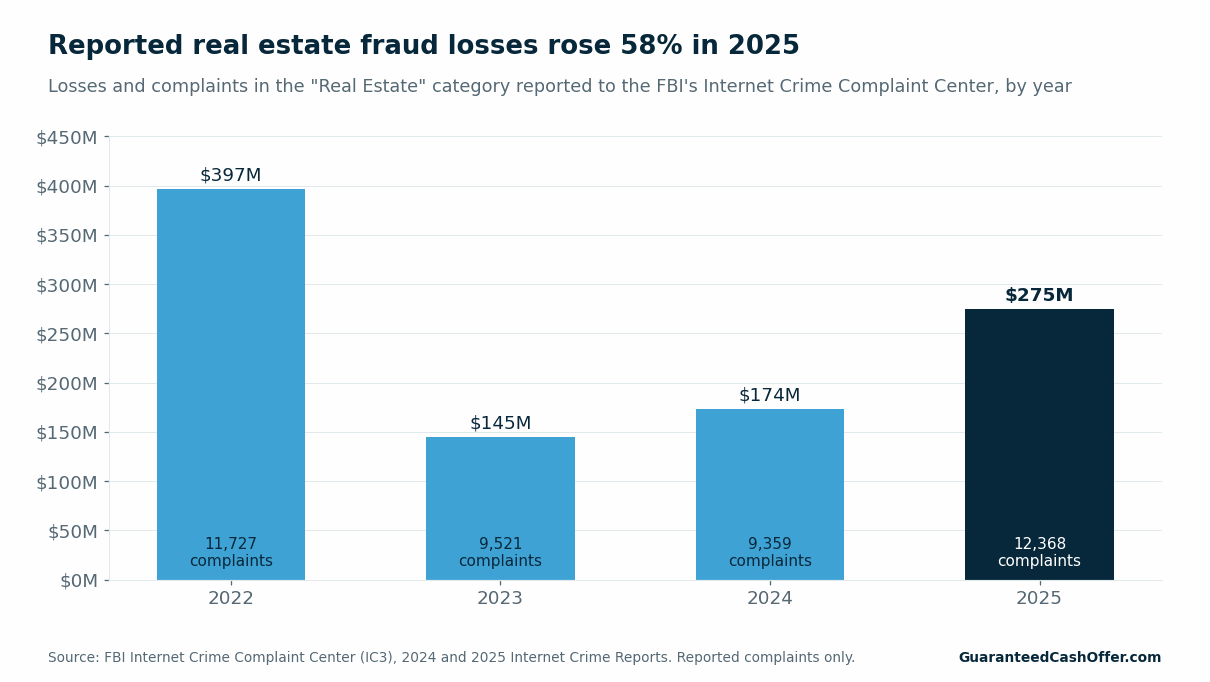
As a seller, you're usually receiving money rather than sending it, but the same tricks are used to redirect your proceeds. Give your payout details only to the closing attorney, and confirm any change by calling a phone number you already know is real, not one in the email.
This isn't legal advice. A purchase contract is binding. If anything in an offer worries you, ask the closing attorney or your own attorney before you sign.
Compare more than one option
The best way to know whether an offer is fair is to compare it with something. Get more than one cash offer if you can, and compare them with what you'd likely net by listing after commissions, repairs, concessions and the months of carrying costs. Our guide to comparing your real net walks through it step by step, and our cash offer vs. listing page lays out the trade-offs.
How Guaranteed Cash Offer helps
With one request, we connect you with vetted local cash buyers and get you a licensed real estate agent's estimate of what your home could sell for if you list it. You see both side by side, so you have a real basis for deciding whether a cash offer is fair. There's no fee and no obligation. You can read how our process works or request your offers here.
Frequently asked questions
Is a cash offer always lower than market value?
Usually, yes, because the buyer is taking on repairs, holding costs and risk, and is paying for speed and certainty. The question is whether the discount is reasonable compared with what you'd spend and wait to sell the traditional way.
What is a fair discount for a cash offer?
There's no single percentage. It depends on your home's condition, your area and how quickly the buyer can resell. A home that needs a new roof and kitchen will draw a bigger discount than one that's move-in ready. The fairest way to judge is to compare the offer with your estimated net from listing.
Can I negotiate a cash offer?
Yes. You can counter on price, closing date, earnest money, the length of the due diligence period, who pays closing costs and when you move out. A serious buyer expects some back and forth.
How can I tell if a cash buyer is legitimate?
Ask for proof of funds, a written contract and the name of the Georgia closing attorney. Look up the company's business registration and reviews. Be cautious if they ask for money upfront, want your deed before closing or rush you to sign.
Should I get more than one cash offer?
If you can, yes. Comparing offers, and comparing them with a listing estimate, is the simplest way to see whether a number is in a fair range.
Sources: Realtor.com Residential Listings Database via FRED, metro Atlanta series MEDLISPRI12060 (median list price) and MEDDAYONMAR12060 (median days on market), through Sept. 2026; Federal Trade Commission, Mortgage Relief Scams; FBI Internet Crime Complaint Center, 2025 Internet Crime Report and 2024 Internet Crime Report (Real Estate crime type; 2022 and 2023 figures from the 2024 report's three-year tables); In re UPL Advisory Opinion 2003-2, Supreme Court of Georgia (2003). Percentages are rounded. Hero photo by Jakub Żerdzicki on Unsplash.