

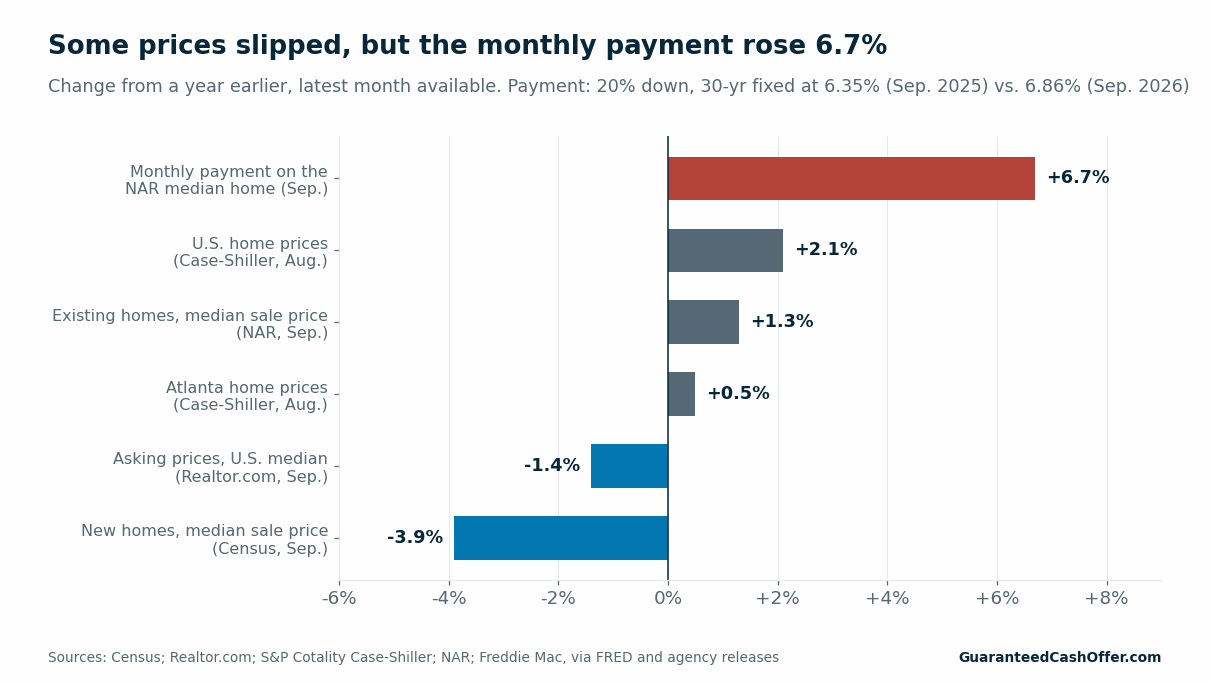
If you've been following housing headlines this fall, you've probably seen some version of "home prices are falling." Part of that is true. The median price of a newly built home sold in September was 3.9% lower than a year earlier, and the typical asking price on Realtor.com was down 1.4%.
But if prices are slipping, why does buying a home feel harder than it did a year ago? Because the price is only half of what a buyer pays. The other half is the mortgage rate, and it went the wrong way. Here's what the latest numbers show, why affordability hasn't improved, and what that means if you're thinking about selling in metro Atlanta.
Which prices actually dipped
There isn't one "home price." Different reports measure different things, and right now they're telling slightly different stories:
- New homes: The Census Bureau reported a median sale price of $400,400 for new homes sold in September 2026, down 3.9% from $416,800 a year earlier. (Census notes this monthly change is within its margin of error, so treat it as a direction, not a precise number.)
- Asking prices: The national median list price on Realtor.com was $419,250 in September, down 1.4% from a year earlier and about 7% below its June 2022 high of $449,000.
- Existing homes that sold: The National Association of REALTORS® (NAR) put the September median at $417,500. That's down from $442,800 in June, which is partly the normal seasonal slowdown, but it's still 1.3% higher than a year ago.
- Repeat sales of the same homes: The S&P Cotality Case-Shiller U.S. index rose 2.1% in the year through August.
So "prices are falling" is true for new homes and for asking prices, and it's true after inflation. S&P's Rebecca Kaufman noted that "U.S. home prices declined in real terms for the 15th consecutive month in August 2026," because a 2.1% price gain didn't keep up with 3.4% inflation. In plain dollars, though, most existing homes are still selling for about what they did last year, or a little more.
Why affordability didn't improve: rates went up
Most buyers don't pay cash. They borrow, so what they really shop with is a monthly payment. According to Freddie Mac, the average 30-year fixed rate was 6.86% in September 2026, up from 6.35% a year earlier. By October 29 it was 7.24%, compared with 6.17% at the same time last year.
Here's what that does to a payment. Take the NAR median price and assume a 20% down payment on a 30-year fixed loan:
- September 2025: $412,300 home at 6.35% = about $2,052 a month in principal and interest.
- September 2026: $417,500 home at 6.86% = about $2,191 a month.
That's roughly $139 more every month, or about $1,670 a year, before taxes and insurance. At October's average rate of about 7.33%, the same home would cost about $2,297 a month. A small dip in price can't offset a jump like that.
NAR's own Housing Affordability Index tells the same story. It was 105.4 in September, down from 106.7 a year earlier. (On that index, a lower number means a typical family has less room to afford a typical home.) NAR's chief economist, Lawrence Yun, put it simply: "Further increases in mortgage rates in recent weeks mean fewer buyers can qualify to purchase a home."
The bigger picture since 2019
Zoom out and the gap is even clearer. Since January 2019, the Case-Shiller national index is up about 62%. Over the same stretch, the monthly principal and interest payment to buy at those prices, using each month's average mortgage rate, is up about 106%. In other words, the cost of financing a home has roughly doubled while prices rose by about three-fifths.
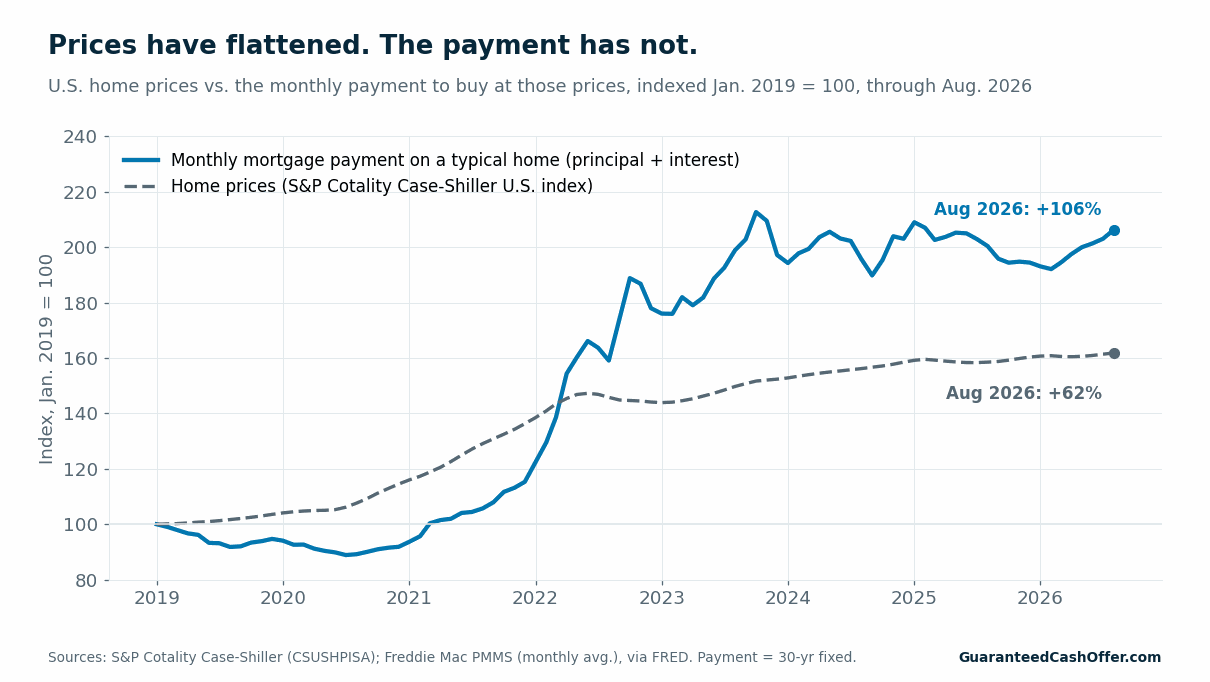
That's why prices that "dip" by a percent or two don't bring buyers rushing back. For most of them, the payment is the number that decides whether they can buy at all.
What it looks like in metro Atlanta
Atlanta is moving even more slowly than the national average. The Case-Shiller index for Atlanta was up just 0.5% in the year through August, and it's slightly below where it stood in early 2025. On Realtor.com, the median asking price for the Atlanta-Sandy Springs-Roswell metro was $415,000 in September, the same as a year earlier and about 8% below its mid-2022 peak.
Meanwhile, buyers have plenty to choose from. There were 29,735 active listings in metro Atlanta in September, and the typical home spent 60 days on the market. We covered how that's showing up as price cuts and closing-cost help in our look at Atlanta price cuts and concessions, and what the record-low contract signings mean in our pending home sales article.
What this means if you're selling
Flat prices with expensive mortgages create a specific kind of market. Buyers aren't disappearing, but they're stretched, careful and comparing a lot of homes. A few practical takeaways:
- Price for the payment, not just the comps. A buyer's lender decides how much they can borrow. If your price only works at last year's rates, it may sit. Yun's advice for sellers was direct: "Home sellers need to be realistic about local market conditions, which could require price discounts and other incentives to attract buyers."
- Consider help that lowers the payment. Sometimes a seller credit toward a rate buydown helps a buyer more than an equal price cut, because it lowers what they pay every month. Ask your agent or lender to run both options.
- Don't count on a rate drop to rescue the sale. Rates have eased a little since early October, but no one can promise where they'll go next. Every month you wait also costs you mortgage, taxes, insurance and upkeep.
- Know your real net. What matters is what you walk away with after commissions, concessions, repairs and carrying costs. Our home sale calculator can help you estimate it.
A softer price doesn't automatically mean a better deal for buyers, and a "falling prices" headline doesn't mean your home has lost value. Look at local numbers and your own timeline before you decide anything.
Where a cash offer fits
Cash buyers don't need a mortgage, so higher rates don't change their ability to close. That can matter if you're on a deadline, if your home needs work that would make it hard for a financed buyer to get a loan, or if you'd rather not spend months negotiating with buyers who are stretched thin.
The trade-off is usually price. A cash offer is often lower than what you might get by listing, repairing and waiting for the right buyer. The best way to decide is to see both numbers side by side. Our cash offer vs. listing comparison explains the differences.
How Guaranteed Cash Offer helps
With one request, we connect you with vetted local cash buyers and a licensed real estate agent's estimate of what your home could sell for if you list it. You see both side by side and decide what's right for you. There's no fee and no obligation. Request your offers here.
Frequently asked questions
Are home prices falling in 2026?
It depends on the measure. New-home prices and median asking prices were lower in September 2026 than a year earlier, and prices are down after inflation. But the median price of existing homes that sold was still up 1.3% from a year ago, according to NAR.
If prices are lower, why is it harder to afford a home?
Because mortgage rates rose more than prices fell. With 20% down, the monthly principal and interest on the NAR median-priced home went from about $2,052 in September 2025 to about $2,191 in September 2026, mainly because the average 30-year rate climbed from 6.35% to 6.86%.
Are home prices falling in Atlanta?
Not much in either direction. Atlanta's Case-Shiller index was up 0.5% in the year through August 2026, and the metro's median asking price on Realtor.com was $415,000 in September, unchanged from a year earlier. Homes are taking longer to sell, though, with a typical 60 days on market.
Should I wait for prices or rates to change before selling?
No one can reliably predict either. Waiting has real costs, including your mortgage, taxes, insurance and maintenance. It's usually worth comparing what you'd net by selling now with what waiting could cost.
Does a cash offer make sense when rates are high?
It can. Cash buyers aren't affected by mortgage rates or loan approvals, which can mean more certainty and a faster timeline. In exchange, the price is often lower than a traditional listing might bring, so compare both before deciding.
Sources: U.S. Census Bureau, New Residential Sales, September 2026 (Oct. 27, 2026); National Association of REALTORS®, "Existing-Home Sales Increased 1.5% in September" (Oct. 13, 2026), and NAR median existing-home price via FRED (HOSMEDUSM052N); S&P Dow Jones Indices, "S&P Cotality Case-Shiller Index Reports Annual Gain in August 2026" (Oct. 27, 2026), and Case-Shiller indexes via FRED (CSUSHPISA, ATXRSA); Freddie Mac Primary Mortgage Market Survey, via FRED (MORTGAGE30US); Realtor.com Residential Listings Database via FRED (MEDLISPRIUS, MEDLISPRI12060, ACTLISCOU12060, MEDDAYONMAR12060). Payment estimates are principal and interest only, with 20% down on a 30-year fixed loan at Freddie Mac's monthly average rate; the 2019-2026 payment line applies the same method to the Case-Shiller index. Hero photo by Sasun Bughdaryan on Unsplash.