

When most people hear "cash offer," they picture one number: the price. But a cash offer is a written contract, and the price is only one line of it. The other lines decide how much money you actually walk away with, how sure the sale is to close, and when you have to be out of the house.
Below we go through a typical cash offer line by line, explain what each part means in plain English, and point out what to check before you sign. We focus on Georgia, where our sellers are, but most of it applies anywhere.
How common are cash sales?
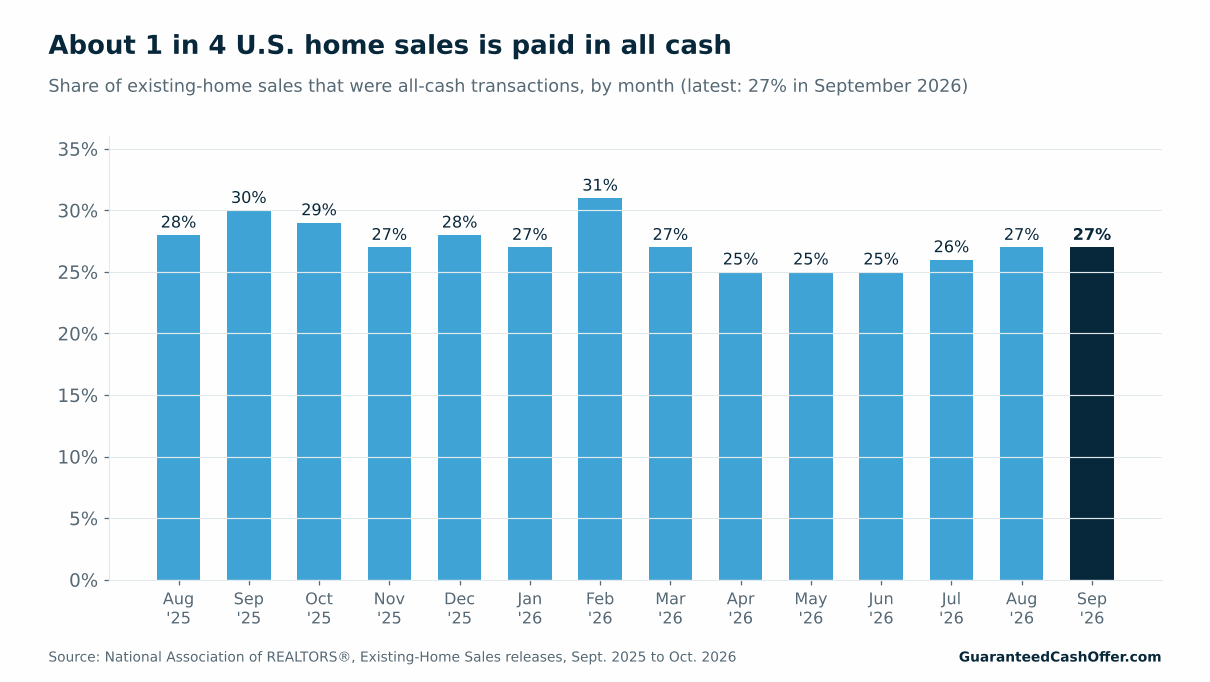
More common than many sellers expect. According to the National Association of REALTORS®, 27% of existing-home sales in September 2026 were all-cash transactions, unchanged from August and down from 30% a year earlier. Over the past year the share has stayed between 25% and 31% every month, so roughly one in four homes sold in the U.S. is bought without a mortgage.
Cash buyers include individual investors, people buying second homes, and homeowners who sold another property and are paying cash for the next one. Because they don't need a lender's approval or appraisal, their offers are built differently from a financed offer. That's why it pays to read every line.
A cash offer, line by line
1. Purchase price
This is the number everyone looks at first. Just remember it isn't what you'll receive. Your mortgage payoff, any liens, prorated property taxes, closing costs and any credits you agree to all come out of it. To compare offers fairly, compare what you'd net, not the headline price. Our home sale calculator can help you estimate that.
2. Proof of funds
A real cash buyer should be able to show they have the money, usually with a recent bank or brokerage statement or a letter from their bank. It's reasonable to ask for this before you accept. If a buyer can't or won't show proof of funds, treat the offer as less certain than it looks.
3. Earnest money
Earnest money is a deposit the buyer puts down to show they're serious. The contract should say how much it is, who holds it (often the closing attorney or a real estate brokerage), and when it's due. Pay attention to when the buyer can still get it back. A larger deposit that becomes non-refundable sooner gives you more security if the buyer walks away.
4. Due diligence or inspection period
Many Georgia purchase contracts give the buyer a set number of days to inspect the home and decide whether to go forward. During that window, the buyer can usually back out for any reason. Shorter is better for you as the seller. A very long period, or vague language like "subject to partner approval," means the buyer is keeping a lot of room to walk away or renegotiate.
5. Contingencies
A financed offer usually depends on the buyer's loan approval and an appraisal. A true cash offer shouldn't have either. Read the contingency section anyway. If you see a financing contingency, an appraisal contingency, or a requirement that the buyer sell another home first, it isn't really a cash offer in the way that matters most: certainty.
6. Closing date and closing attorney
Cash sales can often close faster than financed ones because there's no lender underwriting or appraisal to wait on. The offer should name a target closing date and who will handle the closing. In Georgia, the state Supreme Court has held that only a licensed Georgia attorney may prepare or facilitate the execution of a deed, so a real estate attorney is part of every closing here. Make sure the date works for you, including time to move.
7. Who pays closing costs
The contract should say who pays what. Common items include the attorney's fees, title insurance, recording fees and Georgia's real estate transfer tax, which is $1 for the first $1,000 of the price plus 10 cents for each additional $100 (about $1 per $1,000, so roughly $300 on a $300,000 sale). Some cash buyers offer to pay all closing costs. If they do, make sure it's written into the contract, not just said on the phone.
8. Condition and repairs
Many cash offers are "as-is," meaning you don't make repairs and the buyer accepts the home in its current condition. Check whether the contract still lets the buyer ask for repairs or a lower price after the inspection. "As-is" in the headline and a repair request in week two are not the same deal.
9. Possession and move-out
When do you hand over the keys? Some buyers let sellers stay a few days or weeks after closing, sometimes for a fee. The contract should also say what you can leave behind (furniture, belongings, debris) and whether there's a cost for it.
10. Assignment clause
Look for the words "and/or assigns" after the buyer's name, or a clause that lets the buyer transfer the contract. That can mean the person signing plans to sell the contract to another buyer rather than close on it themselves. That isn't illegal, but you should know who will actually buy your home and whether they've shown proof of funds.
11. Fees and deductions
Read the bottom of the offer and the settlement estimate for any "service fee," "processing fee" or other deduction from your proceeds. A fair offer is clear about every dollar that comes out of the price.
A quick checklist before you sign
| Line | What to check |
|---|---|
| Price | What you'd net after payoff, closing costs and credits |
| Proof of funds | A recent statement or bank letter, in the buyer's name |
| Earnest money | Amount, who holds it, and when it becomes non-refundable |
| Due diligence | How many days, and whether the buyer can renegotiate |
| Contingencies | No financing, appraisal or home-sale contingency |
| Closing | A date that works for you and a named Georgia closing attorney |
| Closing costs | Who pays each item, in writing |
| Condition | Truly as-is, or repair requests still allowed |
| Possession | Move-out date and what you can leave behind |
| Assignment | Whether the buyer can transfer the contract to someone else |
| Fees | Any deductions from your proceeds |
This isn't legal advice. A purchase contract is a binding agreement. If anything in an offer is unclear, ask the closing attorney or your own attorney before you sign.
Comparing a cash offer with listing
A cash offer usually trades some price for speed and certainty. Whether that trade makes sense depends on your home and your timeline. In metro Atlanta, the typical listing spent 60 days on the market in September 2026, according to Realtor.com data, and that's before the time from contract to closing. If you need to move soon, your home needs work, or you'd rather skip showings, a strong cash offer can come out ahead once you count carrying costs. If you have time and the home shows well, listing may net more. Our cash offer vs. listing comparison lays out the differences, and we covered what's driving the slower market in our look at record-low pending sales.
How Guaranteed Cash Offer helps
With one request, we connect you with vetted local cash buyers and get you a licensed real estate agent's estimate of what your home could sell for if you list it. You see both side by side and decide what's right for you. There's no fee and no obligation. You can read how our process works or request your offers here.
Frequently asked questions
What is a cash offer on a house?
A cash offer is an offer to buy a home without a mortgage. The buyer pays the full price from their own funds at closing, so the sale doesn't depend on a lender's approval or an appraisal.
Does a cash offer mean I get paid in cash?
No. "Cash" means the buyer isn't borrowing. At closing, the funds go through the closing attorney, who pays off your mortgage and closing costs and sends you the rest, usually by wire transfer or check.
Can a cash buyer back out?
Usually yes, during the due diligence or inspection period and under any other conditions written into the contract. After that, backing out typically means losing some or all of the earnest money, depending on the contract terms.
Who pays closing costs on a cash sale in Georgia?
Whoever the contract says. Buyers and sellers can split costs any way they agree. Georgia's transfer tax is about $1 per $1,000 of the sale price. Some cash buyers offer to cover all closing costs, so check the contract for exactly what's included.
What does "and/or assigns" mean in a purchase offer?
It means the buyer can transfer the contract to another person or company. Ask who would actually close on your home and whether that buyer can show proof of funds.
Sources: National Association of REALTORS®, monthly Existing-Home Sales releases, Sept. 2025 to Oct. 2026 (for example, "Existing-Home Sales Increased 1.5% in September", Oct. 13, 2026; December 2025's cash share is from the January 2026 release); Georgia Department of Revenue, Real Estate Transfer Tax; In re UPL Advisory Opinion 2003-2, Supreme Court of Georgia (Nov. 10, 2003); Realtor.com Residential Listings Database, via FRED (MEDDAYONMAR12060). Transfer tax example is rounded. Hero photo by Olena Kholina on Unsplash.