

If you've inherited a house, you're probably dealing with a lot at once: grief, family conversations, paperwork, and a home full of someone's life. You don't have to figure it all out today.
This roadmap walks through selling an inherited house in Georgia in plain English: who can sell, how probate fits in, holding costs, taxes and your options.
This isn't legal or tax advice. Every estate is different. A Georgia probate attorney can tell you what applies to your family's situation, and a CPA or tax professional can help with the tax side.
Step 1: Figure out who has the authority to sell
A house left in someone's name usually can't be sold until a person has legal authority to act for the estate. In Georgia, that person is called the personal representative, and a Georgia probate court appoints them.
- If there's a will, it usually names an executor. After the will is probated, the court issues Letters Testamentary. If the named executor can't or won't serve, the court can appoint an administrator "with will annexed."
- If there's no will, the court appoints an administrator and issues Letters of Administration. A guide published by the Cherokee County Probate Court explains that a surviving spouse or sole heir may serve, or a majority of the heirs can choose the administrator.
The letters are the proof of authority. Georgia's probate judges are clear that a personal representative "has no authority to act until the Letters have been issued." Expect the closing attorney to ask for them.
Georgia also has a simpler process called "no administration necessary" for some estates, where the debts are paid (or creditors agree) and all the heirs sign an agreement on how to divide everything. A probate attorney can tell you whether your situation fits.
Does the court have to approve the sale?
It depends on the personal representative's powers. According to the probate judges' handbook, the authority to sell can come from the will, from the law, from a broad court order at or after appointment, or from a court order on a specific petition. A will may give the executor that power directly, and Georgia law lets heirs consent to giving a personal representative extra powers.
Without those broader powers, the personal representative generally files a petition asking the court for permission to sell. Under Georgia's standard form, the petition lists the proposed price and terms, heirs or beneficiaries get notice and a chance to object, and if no one objects the court may grant it without a hearing. Afterward, the sale is reported to the court.
Step 2: Know the timeline you're working with
Probate has a few built-in clocks. The probate judges' handbook lists these for a personal representative:
| Step | Timing in Georgia |
|---|---|
| Letters | Before the personal representative can act, including selling |
| Creditors | Published within 60 days of appointment, once a week for four weeks; creditors then have three months to file claims |
| Inventory | Due within six months of appointment (unless waived) |
| Approval | If the court must approve the sale, heirs are served at least 30 days before the objection deadline |
| Closing | Handled by a licensed Georgia attorney |
| Distribution | After debts, taxes and expenses are paid |
You can still secure the house and get a sense of value while the paperwork moves forward. Just don't sign a sales contract until the person signing has authority.
Step 3: Get a realistic sense of value
Value matters twice for an inherited house: once for the sale, and once for taxes (more below).
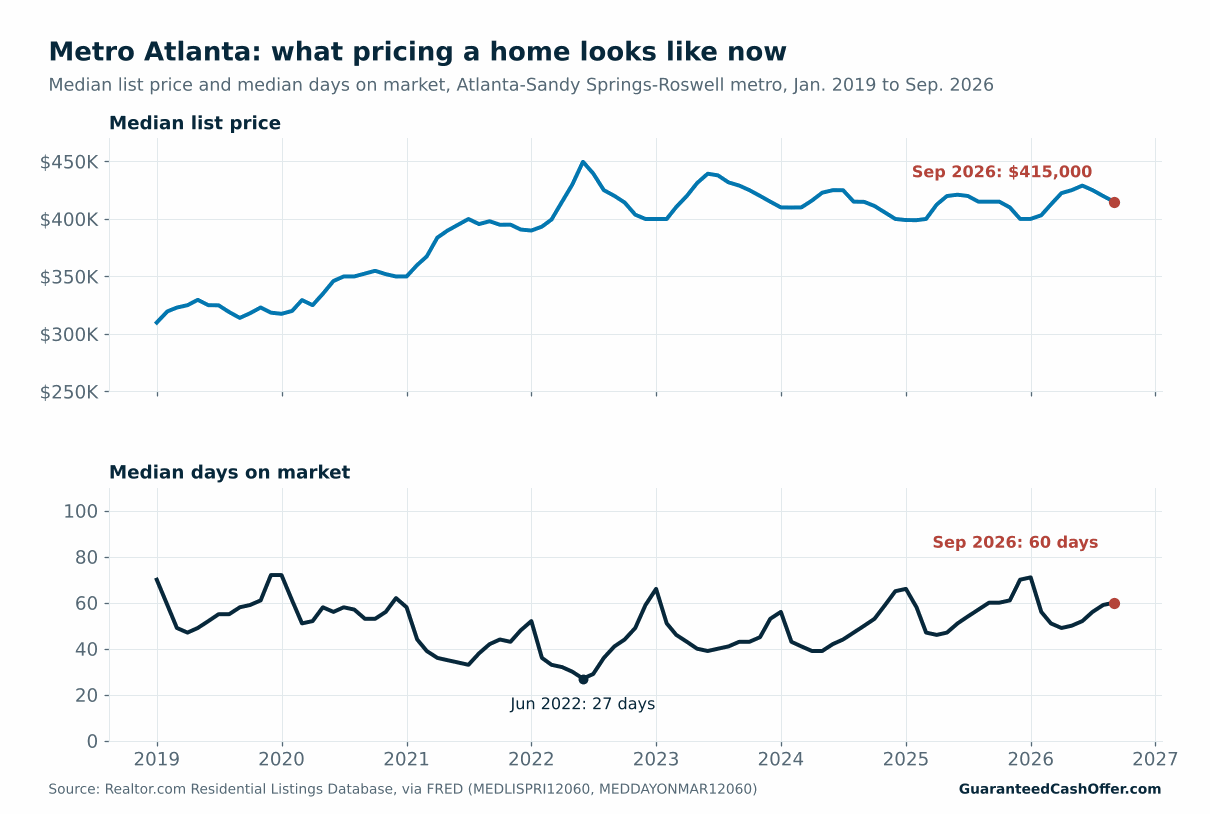
In metro Atlanta, the median list price was $415,000 in September 2026, the same as a year earlier and below the 2022 peak of about $450,000, according to Realtor.com data. The bigger change is time: the typical listing spent 60 days on the market, compared with just 27 days in June 2022. For an inherited house, that's two months or more of carrying costs before a contract, plus the time to close.
If the house needs work, factor that into both the price and the timeline. We go deeper in how to price your inherited home in Atlanta.
Step 4: Protect the house while you decide
The probate judges' handbook says the personal representative should take control of estate property, make sure it's secured, and keep appropriate insurance on it. In practice, that usually means:
- Secure it. Lock up, consider changing the locks, and keep valuables and important papers somewhere safe.
- Call the insurance company. Tell them the owner has died and the house may sit empty. The National Association of Insurance Commissioners has warned that some insurers may not pay claims if a home is vacant for 60 days or more, and many policies have a "vacancy clause." You may need a different policy.
- Keep the basics running. Property taxes, insurance and utilities still come due. Keeping power and water on also makes the house easier to check and show.
Step 5: Understand the tax basics
Georgia estate and inheritance tax. According to the Georgia Department of Revenue, Georgia has no inheritance tax, and state law says that on and after July 1, 2014, "there shall be no estate taxes levied by the state."
Federal income tax when you sell. The IRS says your basis in inherited property is generally its fair market value on the date of death (or on an alternate valuation date, if the executor files an estate tax return and elects it). This is often called a "stepped-up" basis. If you sell for more than that basis, you have a taxable gain, so for a house sold soon after a death the gain may be small. A valuation from around the date of death is worth having; a CPA can tell you how this applies to you.
Step 6: Clean out and decide: repair or sell as-is
Clearing out a loved one's home is often the hardest part. Give yourselves time for the keepsakes, then bring in help for the rest. Before paying for repairs, ask whether they'll come back in the sale price, and who pays for them while the estate is open. Our post on preparing an inherited house for sale has practical tips.
Step 7: Choose how to sell
- List with an agent. Often the way to reach the most buyers and the highest price, especially if the home shows well. Plan for showings, repair requests and today's longer time on market.
- Sell as-is to a cash buyer. Usually faster and simpler, with no repairs or showings, in exchange for a lower price. It can make sense when the house needs work, heirs live out of state, or holding costs are adding up.
- One heir buys out the others. This can keep the house in the family. If the buyer is the personal representative or related to them, the probate judges' handbook suggests getting the court's authority so the sale isn't challenged later.
Whichever you choose, a licensed Georgia attorney handles the closing. Georgia's Supreme Court has held that only a licensed Georgia attorney may prepare or facilitate the signing of a deed. To compare what you'd walk away with, try our home sale calculator.
How Guaranteed Cash Offer helps
With one request, we connect you with vetted local cash buyers and a licensed real estate agent's estimate of what the house could sell for if you list it. You see both side by side and decide what's right for your family, on your timeline. There's no fee and no obligation. You can read how our process works or request your offers here.
Frequently asked questions
Can I sell an inherited house in Georgia before probate is finished?
Often, yes. Once the court issues letters, the personal representative can sell if the will, the law, the heirs' consent or a court order gives them the power. The estate doesn't have to be fully closed first.
Do all the heirs have to agree to sell the house?
Not always. If the personal representative already has power to sell, every heir may not need to sign. If court permission is needed, heirs get notice and a chance to object. A probate attorney can explain how this works for your family.
Do I have to pay Georgia inheritance tax on a house I inherited?
No. The Georgia Department of Revenue says Georgia has no inheritance tax, and there is no Georgia estate tax for deaths on or after July 1, 2014. Federal income tax may apply if you sell for more than the home's value at the date of death.
Should I fix up an inherited house before selling it?
It depends on the house, the budget and how long the family can carry it. Small fixes can help a listing; bigger repairs make sense only if they'll likely come back in the price. Selling as-is is also an option.
Sources: Georgia Council of Probate Court Judges and State Bar of Georgia Fiduciary Law Section, Duties and Responsibilities of Personal Representatives of Decedents' Estates in Georgia (handbook, via Rockdale County Probate Court); Georgia Probate Court Standard Form GPCSF 13, Petition of Personal Representative for Leave to Sell Property; Cherokee County Probate Court, Georgia Probate Proceedings; O.C.G.A. § 53-8-10 and § 53-8-13; Georgia Department of Revenue, Estate Tax FAQ; IRS, Gifts & Inheritances FAQ; NAIC guidance on vacant homes, via Insurance Journal; In re UPL Advisory Opinion 2003-2, Supreme Court of Georgia (Nov. 10, 2003); Realtor.com Residential Listings Database, via FRED (MEDLISPRI12060, MEDDAYONMAR12060). Hero photo by Robin Jonathan Deutsch on Unsplash.