

Not long ago, selling a home meant one path: hire an agent, list it, hold showings and wait. Today you can also take a cash offer from a local investor, request an instant offer from a big online buyer, or try newer hybrids that pay part of the price now and part later. More choice is good news for sellers, but it also makes it harder to know which route leaves you better off.
Here's what the latest data says about how homes are actually being sold, where the newer options fit, and how to compare them without guessing.
Most sellers still use an agent, more than ever
For all the talk about technology replacing agents, the numbers point the other way. In the National Association of Realtors' 2026 Profile of Home Buyers and Sellers, released November 5 and covering sales from July 2025 to June 2026, 92% of sellers used a real estate agent, an all-time high. Only 5% sold on their own (for sale by owner), matching the record low.
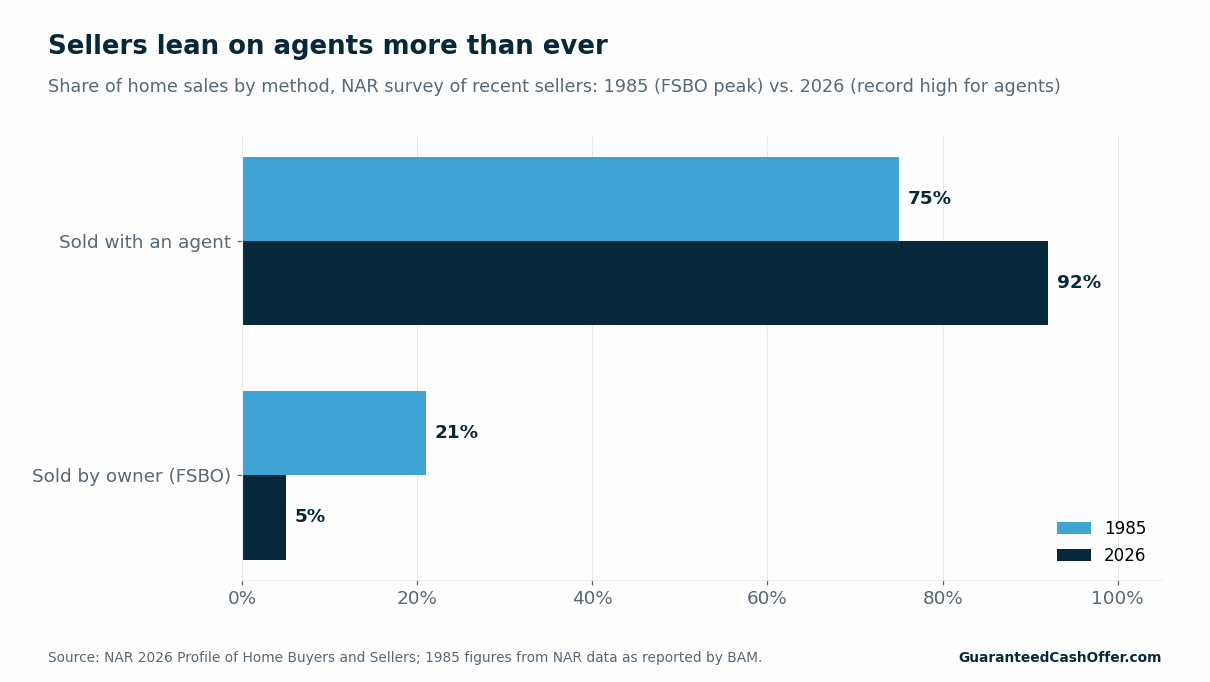
That's a big change from the 1980s. In 1985, the peak year for owner sales in NAR's data, about 21% of homes sold without an agent. Today, most owners who sell on their own already know their buyer. NAR found that 62% of for-sale-by-owner sellers knew the person who bought their home.
The same report shows how long people now stay put. Sellers had owned their homes for a median of 12 years before selling, also a record. If it's been a decade or more since you last sold, the process, the paperwork and the options have all changed.
iBuyers are back, and buying fast
"iBuyers" are companies that make quick, data-driven cash offers online and resell the homes they buy. The largest, Opendoor, was buying relatively few homes a year ago. Now it is growing fast again. In its third-quarter 2026 results, released November 5, Opendoor said it bought 4,865 homes, up from 1,169 a year earlier, while it sold 2,728. It ended the quarter holding 7,596 homes, worth about $2.57 billion.
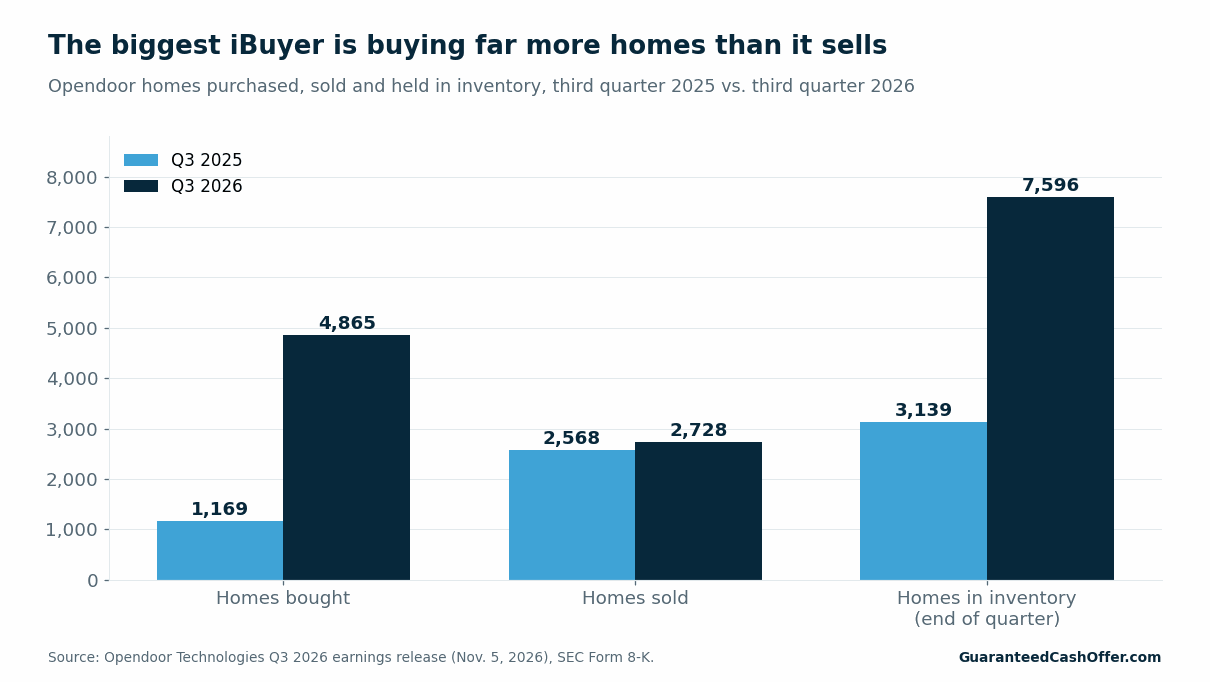
There's a catch for investors in the company, though it's useful context for sellers too: Opendoor's gross margin fell to 3.7% from 7.2% a year earlier, and its quarterly net loss widened to $218 million. Buying more homes is not the same as buying them profitably. Companies in that spot can change their pricing, fees or markets quickly, so an offer you got a few months ago may not look the same today.
"Cash now, more later": the hybrid offer
Most of Opendoor's growth came from a product it now calls Cash Now, More Later (it was called Cash Plus until April). Opendoor says it accounted for more acquisitions in the quarter than all of its products combined did a year earlier. The idea is simple: you get a cash payment and close on your date, move out, and then receive a second payment after the company resells the home. Opendoor says that second payment depends on the home's final sale price, the repairs and market conditions, and that its service charge varies by market and property.
For some sellers, that split can be a reasonable trade: certainty and speed now, with a chance at more later. But it makes offers harder to compare, because part of your money is no longer a fixed number. If you're looking at a hybrid offer, ask:
- What is guaranteed at closing, after the service charge and any repair deductions?
- How exactly is the second payment calculated, and what costs come out of it first?
- When will it be paid, and what happens if the home sells for less than expected or takes a long time?
- What would I net if I listed, so I can see whether the upfront amount alone is worth it?
Cash buyers aren't going away
Cash is a normal part of today's market, not a niche. NAR reported that 27% of existing-home sales in September 2026 were all-cash. Its 2026 Profile found 30% of repeat buyers paid all cash, and a record 10% of first-time buyers did too, often with help from an inheritance.
The mix of cash buyers is shifting, though. Starting January 7, 2027, the 21st Century ROAD to Housing Act limits the largest institutional investors, those owning 350 or more homes, from buying more single-family homes, with some exceptions. We covered what that means in our guide to the new corporate-buyer rules. Local investors and individual buyers paying cash are largely unaffected.
Where your listing shows up is changing too
Even the traditional route is changing. Brokerages, multiple listing services (MLSs) and portals are fighting over "private" or office-exclusive listings, which some buyers never see. If you list, ask your agent where your home will be marketed and why. Our explainer on private listings and the MLS fight covers the questions to ask.
What this means if you're selling
The future of selling isn't one winner. It's more choice, and the sellers who do best are the ones who compare. A few practical steps:
- Get a realistic value first. A licensed agent's listing estimate, based on recent nearby sales, is your baseline.
- Compare net, not price. A higher list price can net less after commissions, repairs, concessions and months of mortgage payments. Our home sale calculator shows the math.
- Get more than one cash offer if speed or condition matters, and check each one for proof of funds, earnest money and a short due diligence period. Our guide to spotting a fair cash offer lists the red flags.
- Read the fine print on fees and hybrid terms. Any fee or deduction should appear in writing before you sign.
- Remember the closing attorney. In Georgia, a licensed attorney handles real estate closings, whichever route you choose.
How Guaranteed Cash Offer helps
We built Guaranteed Cash Offer around choice. With one request, we connect you with vetted local cash buyers and get you a licensed real estate agent's estimate of what your home could sell for if you list it. You see both side by side, so you can pick the path that fits your timeline and your bottom line. There's no fee and no obligation. You can compare cash and listing here, read how our process works or request your offers.
Frequently asked questions
What is an iBuyer?
An iBuyer is a company that uses data and algorithms to make fast cash offers on homes, usually online, then repairs and resells them. They typically charge a service fee and may deduct repair costs from the offer after an inspection.
Are iBuyer offers lower than listing?
Often, because the company is paying for speed and certainty and takes on repairs, holding costs and resale risk. Whether it's worth it depends on what you'd net by listing after commissions, repairs and time on market. Compare the actual net numbers.
How does a "cash now, more later" offer work?
You receive part of the value as cash at closing and may receive a second payment after the buyer resells the home. The second amount isn't fixed. It depends on the resale price, repair costs and market conditions, so ask for the calculation in writing.
Do I still need an agent to sell my house?
No, it's your choice. But 92% of sellers in NAR's latest survey used one, and most owners who sell on their own already know their buyer. Even when you sell for cash, a listing estimate from an agent helps you judge whether the offer is fair.
Will new investor rules affect cash offers in Atlanta?
The federal limits starting January 7, 2027 apply to very large investors that own 350 or more homes. Most local cash buyers are much smaller and aren't covered, so cash offers will remain available. The mix of buyers may shift over time.
Sources: National Association of Realtors, 2026 Profile of Home Buyers and Sellers press release and Top 10 takeaways (Nov. 5, 2026; sales from July 2025 to June 2026); 1985 seller figures from NAR data as reported by BAM; Opendoor Technologies, Q3 2026 earnings release (Nov. 5, 2026) and Cash Plus is now Cash Now, More Later (Apr. 15, 2026); NAR, Existing-Home Sales for September 2026 (all-cash share); 21st Century ROAD to Housing Act, Sec. 1001 (large institutional investor purchase limit). We mention Opendoor because it publishes its results; we have no relationship with it. Hero photo by Vitaly Gariev on Unsplash.