

When you're deciding between a cash offer and listing your home, it's natural to compare the two prices. The listing estimate is almost always higher. But price isn't what you take home. What matters is your net: the money left after every cost of the sale.
This guide walks through the costs on each side, shows a worked example with round numbers, and explains when cash tends to make sense and when listing likely puts more in your pocket. We focus on metro Atlanta and Georgia, where our sellers are.
What "net" really means
Your net is the sale price minus everything that comes out of it before you get paid. That includes agent commissions, credits to the buyer, repairs, closing costs and taxes. Your mortgage payoff comes out too, but it's the same on both sides, so you can leave it out when you compare.
There's one more cost people forget: time. Every month you own the house, you keep paying for it. That's why the speed of each option belongs in the math.
What Atlanta's market says about time
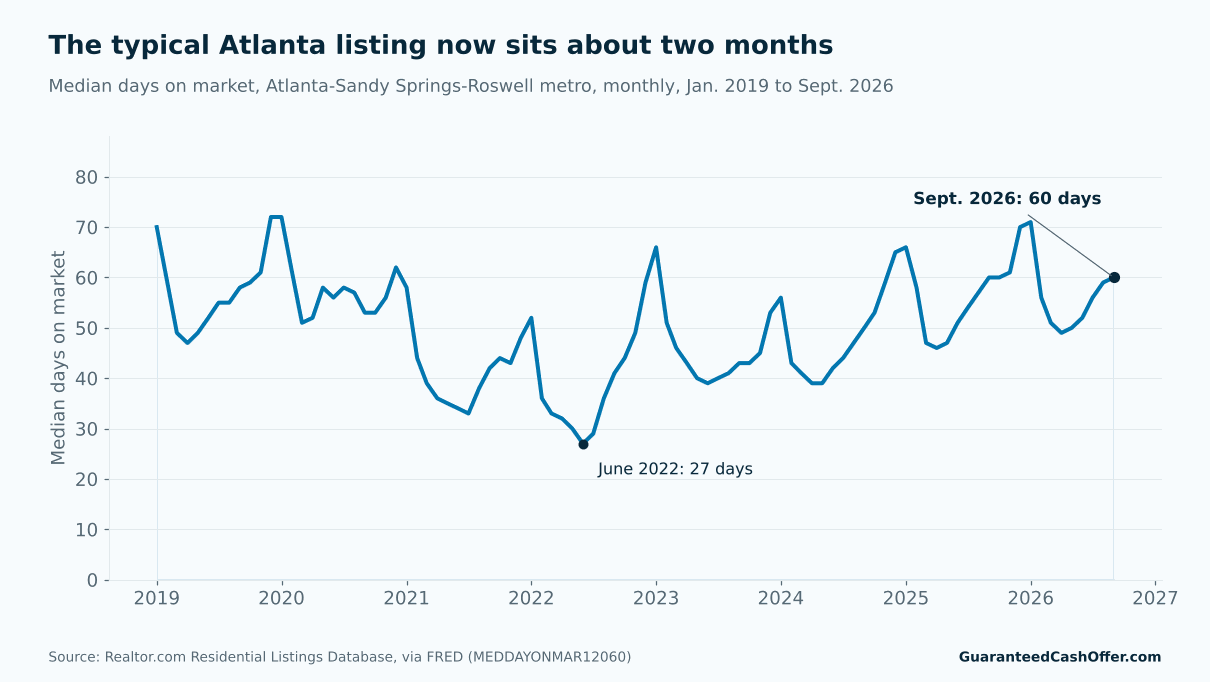
In September 2026, the typical home in the Atlanta metro spent 60 days on the market, according to Realtor.com data. That's the same as a year earlier and well above the 27 days seen in June 2022. And days on market only counts time until a contract. Closing comes after that.
Buyers also have room to negotiate. Redfin found that 72.8% of Atlanta home sales in August 2026 included a seller concession, the highest share of the 29 major metros it analyzed. And 10,700 metro Atlanta listings had a price reduction in September, per Realtor.com. Mortgage rates are part of the reason: Freddie Mac's average 30-year fixed rate was 7.24% the week of October 29.
The line items on each side
Price
Compare the cash offer to a realistic sale price, not your hoped-for list price. A licensed agent's estimate based on recent nearby sales is a good starting point. If price cuts are common in your area, factor that in.
Agent commissions
When you list, you'll usually pay your listing brokerage, and you may also agree to help pay the buyer's agent. Since new practice rules took effect on August 17, 2024, after NAR's settlement, offers of buyer-agent pay can't be posted on the MLS, and buyers sign written agreements with their own agents. NAR says commissions are and remain "entirely negotiable." Ask your agent for the exact numbers in writing. A direct cash sale often has no commission, but check the offer for any fee.
Seller concessions
Buyers often ask for help with closing costs, a repair credit or money to buy down their rate. In Atlanta right now, plan for the possibility. Cash buyers can ask for a lower price after inspection too, so read the terms.
Repairs and prep
Listing usually means getting the home ready: paint, cleaning, small fixes, maybe staging. Then the buyer's inspection can bring more repair requests. Many cash offers are as-is, so these costs often drop to zero.
Carrying costs
While the home is for sale, you still pay mortgage interest, property taxes, insurance, utilities and upkeep. Add up your real monthly cost and multiply by the months you expect the sale to take, from prep to closing.
Georgia transfer tax
Georgia charges $1 for the first $1,000 of the sale price and 10 cents for each additional $100. That's about $300 on a $300,000 sale. It applies whichever way you sell.
Attorney closing costs
In Georgia, a licensed Georgia attorney handles the closing. Who pays the attorney and title costs depends on the contract. Some cash buyers cover them, so check what's written.
The risk a deal falls through
A financed sale depends on the buyer's loan and appraisal. If it falls apart, you start over and keep paying carrying costs. A cash offer removes the financing risk, though a buyer can still walk away during the due diligence period. Certainty doesn't show up as a line on a settlement statement, but it has real value.
A worked example (hypothetical)
Here's an illustration with round numbers. These are assumptions we chose to show the math, not market averages or typical rates. Your numbers will be different.
| Line item | List with an agent | Cash offer |
|---|---|---|
| Sale price | $300,000 | $255,000 |
| Agent commissions (assumed 5% total) | −$15,000 | $0 |
| Concession to buyer (assumed) | −$6,000 | $0 |
| Repairs and prep (assumed) | −$5,000 | $0 (as-is) |
| Carrying costs at $2,000/month (assumed) | −$6,000 (3 months) | −$1,500 (about 3 weeks) |
| Attorney and closing costs (assumed) | −$1,500 | −$1,500 |
| Georgia transfer tax | −$300 | −$255 |
| Net before mortgage payoff | $266,200 | $251,745 |
In this example, listing nets about $14,500 more, even though the price gap was $45,000. Costs closed most of the gap, but not all of it.
Now change one assumption. Say the home takes six months instead of three and sells for $295,000 after a price cut. The listing net drops to about $255,500, only around $3,700 more than the cash offer. If repairs turn out bigger, or a deal falls through and you start over, the gap can disappear.
The point isn't which column wins here. It's that you should fill in both columns with your own numbers before you decide. Our home sale calculator can help.
How to compare offers fairly
- Use the same costs on both sides. If you count closing costs for one option, count them for the other.
- Use a realistic timeline. Include prep time, days on market and time from contract to closing.
- Use your real monthly costs. Pull your mortgage statement, tax bill, insurance and utility bills.
- Read every line of the cash offer. Look for fees, repair requests and the due diligence period. Our guide to what a cash offer looks like, line by line walks through each part.
- Get the agent's numbers in writing. Ask for an estimated price range, the commission and expected concessions.
- Put a value on certainty and time. A smaller net may be worth it if you need to move by a set date.
When cash makes sense, and when listing likely nets more
Listing often nets more when you have time, the home is in good shape and you can handle showings. In that case, the open market usually rewards you.
A cash offer can come out ahead, or close enough, when the home needs significant repairs, when you're paying two housing costs at once, when you need to move by a certain date, or when you'd rather skip showings and repair negotiations. Inherited homes and homes with tenants often fit here too.
Our cash offer vs. listing comparison lays out the differences side by side.
How Guaranteed Cash Offer helps
With one request, we connect you with vetted local cash buyers and get you a licensed real estate agent's estimate of what your home could sell for if you list it. You see both side by side and decide what's right for you. There's no fee and no obligation. You can read how our process works or request your offers here.
Frequently asked questions
Is a cash offer always lower than listing?
The price usually is. Your net may be closer than the prices suggest, because a cash sale often has no commission, no repairs and a shorter timeline. Compare the nets, not the prices.
How do I estimate my net proceeds when selling a house in Georgia?
Start with a realistic sale price. Subtract commissions, concessions, repairs, carrying costs, attorney and closing costs, and the state transfer tax. Then subtract your mortgage payoff to see what you'd receive.
Are real estate commissions negotiable?
Yes. NAR says commissions are and remain entirely negotiable. Since August 2024, buyer-agent pay is no longer offered on the MLS, and buyers sign written agreements with their agents.
Who closes a home sale in Georgia?
A licensed Georgia attorney. The Supreme Court of Georgia has held that only a licensed Georgia attorney may prepare or facilitate the execution of a deed.
Can I get a cash offer and a listing estimate at the same time?
Yes. That's the easiest way to compare. With Guaranteed Cash Offer, one request gets you both, side by side, with no fee and no obligation.
Sources: Realtor.com Residential Listings Database for the Atlanta-Sandy Springs-Roswell metro, via FRED (MEDDAYONMAR12060, PRIREDCOU12060); Redfin, "Nearly Half of Homebuyers Get Concessions From Sellers as Most Markets Tip in Buyers' Favor" (Sept. 18, 2026); Freddie Mac Primary Mortgage Market Survey, via FRED (MORTGAGE30US); National Association of REALTORS®, "The Truth About the NAR Settlement Agreement" and "The Facts"; Georgia Department of Revenue, Real Estate Transfer Tax; In re UPL Advisory Opinion 2003-2, Supreme Court of Georgia (Nov. 10, 2003). The worked example is hypothetical; its figures are assumptions, not market data, and are rounded. This article is general information, not legal, tax or financial advice. Hero photo by Cht Gsml on Unsplash.