

If you've missed a mortgage payment or two, you're not alone, and you likely have more time and more options than it feels like right now. The hardest part is usually the first phone call. The most costly move is waiting.
This guide walks through how foreclosure works in Georgia, the protections federal rules give you, where to find free help, and the options worth comparing before a sale date is ever set.
This isn't legal advice. Foreclosure rules and your loan documents matter, and every situation is different. A HUD-approved housing counselor or a Georgia attorney can tell you what applies to you, and free legal help is listed below.
Foreclosures are rising, but they're still far from 2009
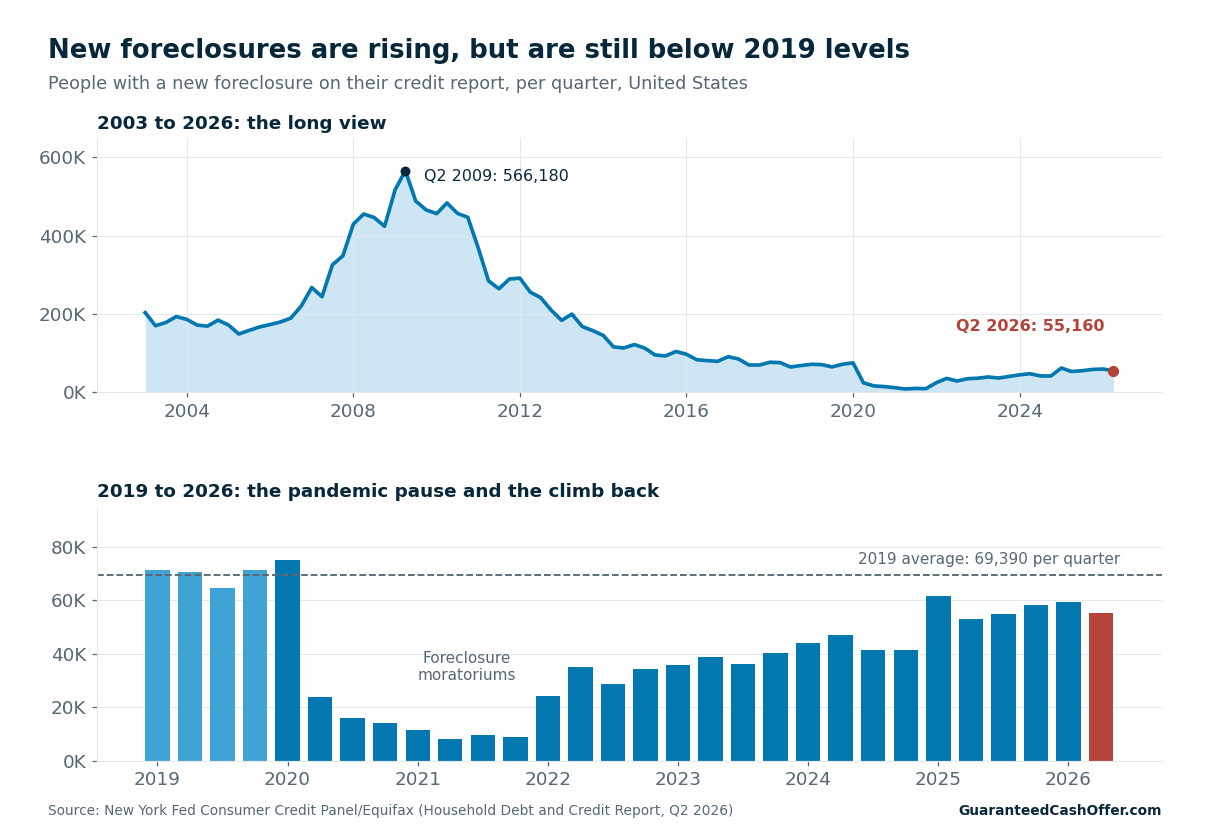
Nationally, about 55,000 people had a new foreclosure added to their credit report in the second quarter of 2026, according to the New York Fed. That's up from the near-zero levels of the pandemic moratoriums, but still below the 2019 average of about 69,000 a quarter, and a fraction of the roughly 566,000 at the 2009 peak.
Georgia has seen a sharper rise. ATTOM, which tracks public foreclosure filings, counted 8,433 Georgia properties with a foreclosure filing in the first half of 2026, up 52% from a year earlier, the third-largest increase among states with at least 500 filings. In August 2026, Georgia had 1,189 foreclosure starts, the fifth most of any state and up about 38% from August 2025.
Mortgage delinquencies have edged up too. The Mortgage Bankers Association put the national delinquency rate at 4.37% of loans in the second quarter of 2026, up 0.44 percentage points from a year earlier. ATTOM's CEO, Rob Barber, called the trend "a continued normalization of the foreclosure process," while noting that the increases "suggest that some homeowners may be facing greater financial strain than they were a year ago."
How the timeline works in Georgia
Georgia is a non-judicial foreclosure state. That means a lender with a "power of sale" in the security deed can sell the home at a public auction without going to court. It can move faster than in many states, which is why the early months matter so much.
| When | What happens |
|---|---|
| Day 36 | By this day, your servicer must try to reach you by phone or in person about options (federal rule) |
| Day 45 | By this day, your servicer must send a written notice about loss mitigation options (federal rule) |
| Day 120 | In most cases, the first foreclosure notice can't be made until you're more than 120 days behind (federal rule) |
| 30 days | At least 30 days before the sale: written notice by certified or registered mail, naming who can negotiate and modify your loan (Georgia law) |
| 4 weeks | For the four weeks before the sale, it is advertised weekly in the county's legal newspaper (Georgia law) |
| Sale | First Tuesday of the month, at the county courthouse, between 10 a.m. and 4 p.m. |
Two details worth knowing. First, the Georgia notice must include the name, address and phone number of the person or company with "full authority to negotiate, amend, and modify" your loan. That's who to call. Second, the law doesn't require the lender to agree to a change. It requires them to tell you who can.
The protections you have
- The 120-day window. Under federal Regulation X, a servicer generally can't make the first foreclosure notice or filing until you're more than 120 days delinquent. Use that time.
- No "dual tracking." If you send a complete application for help more than 37 days before a scheduled sale, the servicer can't hold the sale while it's being reviewed, unless you're found ineligible (and any appeal is over), you turn down the options, or you don't keep up with an agreement.
- A right to appeal. If a complete application arrives 90 days or more before a sale and you're denied a loan modification, you can appeal.
- A check on deficiencies. If a foreclosure sale brings less than you owe, Georgia law says the lender can't pursue a deficiency judgment unless it reports the sale to the superior court within 30 days and the court confirms the home sold for its true market value.
Your options, from keeping the house to selling it
The Consumer Financial Protection Bureau lists five main paths. Which one fits depends on whether your hardship is short-term, whether you want to stay, and how much equity you have.
- Forbearance. Your servicer pauses or lowers payments for a set time. Ask exactly how the missed amount gets repaid afterward.
- Repayment plan. You catch up by adding part of the past-due amount to your regular payments over several months. Works best when the hardship is behind you.
- Loan modification. The servicer changes the loan's terms, such as the rate or length, to make payments more affordable for the long run.
- Short sale. If you owe more than the home is worth, the lender may agree to let you sell for less than the balance. It needs the lender's approval and takes time.
- Deed-in-lieu of foreclosure. You give the home back to the lender instead of going through a foreclosure sale.
Selling on your own terms
If you have equity, selling before a foreclosure sale is often the way to protect it. In a sale you control, the payoff goes to the lender and what's left after costs comes to you. Run your numbers with our home sale calculator.
Timing is the catch. In metro Atlanta, the typical listing spent 61 days on the market in October 2026, according to Realtor.com data, and that's before the time it takes to close. If you're already a few months behind, a listing may not finish ahead of a sale date. That's where comparing a listing with a cash sale can help, and why it's worth starting early. If you get cash offers, our guide to spotting a fair cash offer shows what to check.
Free help in Georgia (and scams to avoid)
- HUD-approved housing counselors. Foreclosure counseling is free. Call (800) 569-4287 and enter your ZIP code, or the HOPE Hotline at (888) 995-4673, which the CFPB says is open around the clock.
- Free legal help. Atlanta Legal Aid Society's Home Defense Program represents homeowners in Fulton, DeKalb, Cobb, Gwinnett and Clayton counties (Fulton office: 404-524-5811). Outside metro Atlanta, Georgia Legal Services Program helps homeowners facing foreclosure at 1-833-457-7529.
- State assistance. The Georgia Mortgage Assistance program stopped taking new applications on February 28, 2026, so don't count on it, and be wary of anyone who says they can get you into it.
The CFPB warns about "foreclosure relief" companies that charge up-front fees, tell you to stop paying your mortgage, or try to get you to sign over the title to your home. As the bureau puts it, "You don't have to pay anyone to help you avoid foreclosure." Learn more on our stop foreclosure page.
How Guaranteed Cash Offer helps
If selling is on the table, one request connects you with vetted local cash buyers and a licensed real estate agent's estimate of what your home could sell for on the open market. You see both side by side, so you can weigh speed against price while there's still time to choose. There's no fee and no obligation. You can read how our process works or request your offers here.
Frequently asked questions
How long does foreclosure take in Georgia?
Georgia's non-judicial process can move quickly once it starts. Federal rules generally block the first foreclosure notice until you're more than 120 days behind. After that, Georgia law requires at least 30 days' written notice and four weeks of newspaper ads before a sale, which is held on the first Tuesday of the month.
Can I sell my house in Georgia if it's in foreclosure?
Generally, yes, up until the foreclosure sale. The loan is paid off at closing from the sale proceeds. If you owe more than the home is worth, you'd need the lender's approval for a short sale. Starting early gives you the most choices.
Will my lender stop a foreclosure if I apply for help?
If your servicer receives a complete application more than 37 days before a scheduled sale, federal rules say it can't hold the sale while your application is being reviewed, with some exceptions. Send everything they ask for, keep copies, and ask them to confirm in writing that your application is complete.
Do I have to pay someone to help me avoid foreclosure?
No. Your servicer and HUD-approved housing counselors help at no cost. The CFPB warns that companies charging up-front fees for foreclosure relief are a red flag.
What happens if a foreclosure sale brings less than I owe?
In Georgia, a lender that wants a deficiency judgment must ask the superior court to confirm the sale within 30 days, and the court must be satisfied the home sold for its true market value. An attorney can explain how this applies to your loan.
Sources: Federal Reserve Bank of New York, Household Debt and Credit Report, Q2 2026 (Aug. 11, 2026; data workbook, New York Fed Consumer Credit Panel/Equifax); ATTOM, 2026 Mid-Year U.S. Foreclosure Market Report (July 16, 2026) and August 2026 U.S. Foreclosure Market Report (Sep. 17, 2026); Mortgage Bankers Association, National Delinquency Survey, Q2 2026; Regulation X, 12 CFR 1024.41 and 12 CFR 1024.39; O.C.G.A. § 44-14-162.2, § 44-14-162, § 9-13-140, § 9-13-161 and § 44-14-161; CFPB, How to avoid foreclosure, If I can't pay my mortgage loan, what are my options? and How to spot and avoid foreclosure relief scams; Georgia Department of Community Affairs, Georgia Mortgage Assistance deadline notice (Feb. 26, 2026); Atlanta Legal Aid Society, Home Defense Program; Georgia Legal Services Program, Housing; Realtor.com Residential Listings Database, via FRED (MEDDAYONMAR12060). Hero photo by Vitaly Gariev on Unsplash.